The 21st-Century Learning Environment
Step into a classroom in the 21st century, and the odds are it won’t look all that different from one in the 20th century. One decade into the 2000s, many schools and universities have been frustrated in their efforts to upgrade their facilities and resources because of shrinking budgets.
But even with the ailing economy, some education institutions have acquired the wherewithal to take advantage of new technologies and design strategies to provide better learning opportunities and more environmentally sensitive facilities.
Technically speaking
In the 1990s, when the Clinton administration embraced the concept of "building a bridge to the 21st century," the main component of that bridge was technology. For schools and universities seeking to transform their learning spaces to meet modern expectations, improving technology is what will make that goal achievable.
The U.S. Department of Education’s National Educational Technology Plan 2010 makes several recommendations for improving the technology infrastructure in schools so that students can maximize their learning opportunities:
•Students and educators should have broadband access to the Internet and adequate wireless connectivity in and out of school. The plan defines "adequate" as "the ability to use the Internet in school, in the surrounding campus, throughout the community and at home."
•Every student and educator should have at least one Internet access device and appropriate software for research, communication, multimedia content creation and collaboration.
"The challenge for our education system is to leverage the learning sciences and modern technology to create engaging, relevant, and personalized learning experiences for all learners that mirror students’ daily lives and the reality of their futures," the executive summary of the plan states. "In contrast to traditional classroom instruction, this requires that we put students at the center and empower them to take control of their own learning by providing flexibility on several dimensions."
No borders
The advances in technology have eroded the connection some students have with their campus library. For generations of students at colleges and universities, a typical trip to the library involved hauling a weighty backpack of textbooks from a residence hall or classroom building to a facility across campus. But students today can tap into online storehouses of data that bring research directly to their personal computers; valuable and unique information still may be found at a campus library, but when students sitting in their residence-hall room can find enough to get by, they are less likely to make the trek to the library.
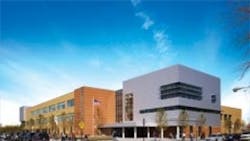
When Marquette University Law School in Milwaukee began plans to build a new facility, it looked for ways to make its library more relevant to needs and expectations of modern students. The result can be found in Eckstein Hall, an $85 million facility that opened in July 2010. The 200,000-square-foot building replaces the venerable but increasingly inadequate Sensenbrenner Hall, which housed the law school since it was built in 1924.
One of the unique features of Eckstein Hall is what the school is calling a "library without borders." Instead of being housed in a separate facility, or isolated on a separate floor, the law library is integrated into all four floors of the building.
"Law libraries used to be repositories for printed materials and places for quiet study; they are now also service-intensive on-ramps to vast digital resources," the school says.
Students and professors gain access to library materials and services without having to leave the building or go through a security checkpoint. The library provides convenient access to the law school’s extensive print-based collection and makes online access readily available to carry out more research.
Other key features of Eckstein Hall:
•Aitken Hall, a 1,348-square-foot drawing room designed to facilitate quiet study and reflection. It features a two-story ceiling, a fireplace, and expansive windows with a view of downtown Milwaukee.
•A 1,964-square-foot amphitheater-style trial courtroom that is equipped with technology comparable to a federal courtroom.
•Zilber Forum, a four-story atrium that will serve as a gathering and meeting space that the school envisions as the heart of the building.
The law school facility also incorporates numerous sustainable design features and has received a silver LEED rating from the U.S. Green Building Council. Shepley Bulfinch, the architectural firm that designed the building, says the environmentally friendly characteristics of Eckstein Hall include a 41-percent reduction in water usage through low-flow plumbing fixtures; and substantial use of materials that are recycled or have low volatile-organic-compound content. Forty-two percent of the building materials came from within a 500-mile radius of the construction site.
Let's go to the replay
Technological improvements not only provide more interactive ways for students to learn during a class, but also they provide the capability to enhance or catch up on lessons.
Mike McCraith, an assistant math professor at Cuyahoga Community College, based in Cleveland, served on the technology committee at the school and helped persuade officials to acquire portable interactive whiteboards as a less costly alternative to installing the equipment in every classroom.
He is able to move the portable whiteboard from classroom to classroom and can set it up in just a few minutes. The device enables him to provide interactive content on any flat surface. In addition, he uses software to record his class lectures so that students who miss sessions or don’t understand the content can review the multimedia files online.
"The students like knowing that there’s a backup of the class, so they don’t have to worry about copying everything that’s on the board," says McCraith.
McCraith’s "Math According to Mike" website provides audio and video podcasts of math lessons that students can download.
Modern schools
Many schools and universities have had to put the brakes on facility improvements because of a shortage of funds. Chicago has been able to continue constructing schools through its Modern Schools Across Chicago program, which uses money from Tax Increment Financing (TIF) districts to pay for new classrooms.
In many communities, governments have used TIF to boost private development in areas that are determined to need an economic boost. But that often occurs at a cost to school districts: Instead of receiving the benefits of a growing tax base, a TIF diverts tax funds from school districts and other governmental agencies and allocates them for improvements in a TIF district. By viewing construction of new schools as a catalyst for economic development, Chicago has been able to make the case for allocating TIF money to schools.
The program was established in 2006 and has earmarked more than $1 billion for school construction projects, which are managed through the Public Building Commission of Chicago. The commission says that all the projects in the Modern Schools program are designed to meet at least a silver LEED standard and try to use prototype designs to conserve costs.
So far, the program has paid for 12 new public schools in the city, and several more that are in the works. Five campuses opened for the 2010-11 school year:
•Eric Solorio Academy High School, together with the nearby Sandoval Elementary School and Hernandez Middle School, completes a "linear" campus on the city’s southwest side. Using the system’s prototype "Urban Model High School" design, the high school expects to receive a silver LEED rating. Its 209,000 square feet includes science, computer, visual and performing-arts classrooms, as well as a library, a gymnasium, a swimming pool, playing fields and tennis courts. Independent entrances for both the library and the athletic wing enable the community to use the facilities on evenings and weekends.
•Federico Garcia Lorca Elementary School. The three-story, 106,000-square-foot facility was built with the system’s C-shaped prototype design for accommodating 900 students. The school will house pre-kindergarten through eighth grade. With sustainable elements such as a combination green and reflective roof, the school was designed to receive silver LEED certification and is on track to achieve a gold rating. The facility’s gym, dining room and other specialty spaces are designed to be available for community use when classes are not in session.
•Calmeca Academy of Fine Arts and Dual Language used the system’s L-shaped prototype design for a 900-student building. Children there, including about 400 kindergarten through 4th graders who will receive instruction in Mandarin Chinese this year, can study various world languages. About 100 pre-k and kindergarten students will be taught Spanish and English as part of the school’s dual-language program. The three-story, 105,000-square-foot facility has a 900-student capacity and includes a combination green and reflective roof to combat the urban heat-island effect.
•Mariano Azuela Elementary School also was built using the Chicago district’s L-shaped prototype for 900-student facilities. It accommodates pre-kindergarten through eighth grade and includes a combination of green and reflective roofing. The green roof also helps absorb noise from nearby Midway Airport.
•West Ridge Elementary School also was built with the L-shaped prototype design. It includes a combination green and reflective roof and has separate entrances to accommodate community use on evenings and weekends.
Keeping tabs on innovation
The computer innovations that are pushing progress in the technological world inevitably make their way to the classroom—from standalone desktop computers to machines connected to the Internet to laptop computers with wireless connectivity.
As more tablet computers (such as iPad, Galaxy Tab and Xoom) are introduced into the market, many schools are acquiring the devices and trying to see how the technology can enhance student learning.
The Indiana Department of Education received applications from 135 school systems or individual schools and has awarded 22 classroom innovation grants of up to $200,000 each. Several of those grants will be used to provide students with tablet computers:
•The Smith-Green district will acquire tablet devices for all its 800 students in grades 5 to 12.
•The Rochester district plans to acquire tablet computers for second graders at Columbia Elementary School as part of a reading improvement program.
•The Center Grove district will use its grant to expand a pilot program that uses tablet devices to provide additional help to students who are English language learners, receiving special-education services or in kindergarten.
Kennedy, staff writer, can be reached at [email protected].
Related Stories
About the Author
Mike Kennedy
Senior Editor
Mike Kennedy, senior editor, has written for AS&U on a wide range of educational issues since 1999.