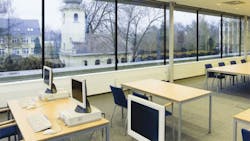
The green movement in school design encompasses many techniques to improve the environmental friendliness and energy efficiency of a facility. Some are more complicated than others — probably not many people can explain the intricacies of a geothermal heating system, or the specifics of how solar or wind energy is harnessed. But most people can understand, on some level, the energy-saving benefits of daylighting. They've seen it in their own homes: When the bright sky floods through their windows, they can get by with less artificial lighting.
But to truly tap into all the benefits of daylighting in learning environments, including improved academic performance from students, designers have to use approaches more sophisticated than just adding more and larger windows, and letting the sunlight stream in.
Windows renaissance
The appeal of windows in a classroom and other learning spaces began to lose out in the 1960s to other factors. More schools were being built with air conditioning, and planners concluded that having an abundance of windows would mean the air-conditioning system would run less efficiently. Administrators also were becoming more concerned about campus security, and the more windows a school had, the more opportunity vandals had to damage or break into buildings. Some educators expressed concerns that classroom windows were an invitation to students to let themselves become distracted by what was happening beyond the school walls.
By the 1990s, more school facilities were being constructed, and builders could choose more energy-efficient windows that did not compromise a building's climate-control system. Among designers, a consensus began to grow that daylight once again was considered desirable and beneficial for education spaces.
The study most often cited for jump-starting the embrace of daylighting in school design, a 1999 report from the Heschong Mahone Group, "found a uniformly positive and highly significant correlation between the presence of daylighting and student performance."
Be aware of glare
But the details of the study made it clear that not any kind of daylight would bring about such positive results. Windows and skylights that created glare on walls or desks affected performance negatively.
Regarding classroom skylights, the systems that performed well provided diffuse distribution of daylight by using diffusing lenses or diffusing louvers and wells; prevented direct penetration of sunlight into classrooms; and enabled teachers to directly control the amount of daylight by using louvers or blinds. The systems that did not perform well or had negative effects allowed direct partially diffuse sunlight into classrooms; relied on automatic controls, which were not performing as originally intended; and created small areas of very high daylight illumination.
"It was clear that successful daylighting from windows prevented the penetration of direct sunlight into classrooms," the report says.
The report concluded that designs should incorporate strategies such as light shelves, roof monitors, baffles, louvers and reflective surfaces to spread light throughout a learning space.
"It is critical that in all classrooms, gymnasiums, media centers and administrative spaces, sunlight is either bounced, redirected or filtered so that direct radiation does not enter a part of the room where this could be problematic," says "The Design Guide for Daylighting Schools," created by the architectural firm Innovative Design.
Daylight emerges
This decade, the twin benefits of greater energy efficiency and higher academic scores have made daylighting strategies an almost obligatory part of modern school construction.
"Rather than selecting fenestration simply for view or aesthetics, architects must now carefully consider the amount and distribution of daylight," says the Collaborative for High Performance Schools (CHPS) Best Practices Manual.
The CHPS guidelines state that all interior spaces where students or staff will be working for extended periods of time should have view windows that provide access to exterior views. "A view window should be optimized for the visual comfort of the occupants, rather than for provision of daylight," the manual says.
High clerestories are used in perimeter walls to admit daylight deep into a space. Using light shelves or louvers with clerestories can improve daylight distribution. Toplighting from skylights or roof monitors also helps distribute daylight evenly throughout a room.
The manual lays out six principles to guide designers incorporating daylighting into an education facility:
-
Prevent direct sunlight penetration into the space. "It is essential that designers understand the basic principles of solar orientation, climate conditions and shading systems," the manual says. "… The first step in good daylighting design is the thoughtful orientation of the buildings on the site, and orientation and size of the fenestration openings."
-
Provide gentle, uniform light throughout the space. "Evenly diffused daylight will provide the most energy savings and the best visual quality," CHPS asserts. "… It is easiest to achieve uniform daylight illumination through toplighting strategies."
-
Avoid creating sources of glare. "Eliminate glare by obscuring the view of bright sources and surfaces with blinds, louvers, overhangs, reflectors, and similar automatic or manually operated devices," the manual says.
-
Allow occupants to control the daylight with operable louvers or blinds. "Exterior shading is the most energy-efficient, since it intercepts the solar gain before it enters the building," the CHPS states.
-
Design the electrical lighting system to complement the daylighting design. "The electric lighting should be circuited and controlled to coincide with the patterns of daylight in the space," the CHPS says. "… Manual controls are substantially less expensive, but they need to be convenient and well labeled to ensure their use. Automatic controls assure savings, but they are more expensive and must have overrides so the occupants can darken the room for audio-visual use or when they just don't want the lights on."
-
Lay out interior spaces to take advantage of daylight conditions. "It is important to locate work areas where appropriate daylighting exists," the manual says. "… In general, work areas should be oriented so that daylighting is available from the side or from above. Facing a window may introduce direct glare into the visual field, while facing away from a window may produce shadows or reflected glare."
To help planners visualize how and to what extent daylight will enter a building, computer programs are available that simulate how daylight and electric light illuminate a space. "These tools are effective in integrating the contributions from windows and skylights, as well as electric lighting systems," the CHPS manual states.
Kennedy, staff writer, can be reached at [email protected].
Sidebar: Bouncing the light
Daylighting is a key component in the design of Reedy Fork Elementary School, a 725-student facility that opened last year in Greensboro, N.C.
Innovative Design, architect for the project, says the school has curved, translucent light shelves and reflective ceiling tiles inside classrooms to provide uniform levels of light while using 40 percent less glass than what is normally used in daylighting applications.
"Because of the translucent nature of the light shelf and the design of the aperture, glare is minimized," the firm says.
The facility also has south-facing roof monitors with translucent fabric baffles in the light wells that distribute natural light throughout the interior.
"Clear double glazing is used to maximize visible light transmittance and minimize glass-to-floor ratio," the firm says. "Adequate overhangs over the monitor windows protect the spaces from direct light during peak periods."
25 to 40
The percentage share of a typical school's energy costs attributed to lighting.
Source: U.S. Department of Energy
30 to 40
The percentage recommended window-to-wall ratio for effective daylighting.
Source: Lawrence Berkeley National Laboratory, "Tips for Daylighting with Windows."
About the Author
Mike Kennedy
Senior Editor
Mike Kennedy, senior editor, has written for AS&U on a wide range of educational issues since 1999.