These are tough economic times, and few groups are more cognizant of this than school and university administrators. Struggling with significantly smaller operating budgets, institutions are faced with the harsh realities of laying off qualified teachers and staff, increasing class sizes, limiting or eliminating valuable programs and, in some cases, closing schools.
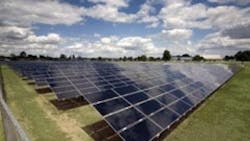
However, it’s not all doom and gloom. Many progressive institutions are developing onsite solar power-generating solutions to help them cut operational costs; hedge against rising electric bills; and create clean, renewable energy. Solar photovoltaic (PV) systems also are enriching various school curricula which, in turn, is preparing students for the growing green jobs sector.
Solar power has been around commercially for almost half a century now, but only recently has it started showing up in noticeable amounts on the roofs, parking lots and ground space of school campuses. Solar PV costs have decreased dramatically during the past decade and with the federal government’s extension (until 2016) of significant tax credits for renewable energy, paired with state and local incentives, there are a lot of economic reasons for schools to turn to solar electricity.
Financing Options
So how are schools making this work? They can leverage available private/public partnership programs and public financing options to make onsite solar generation a reality. Various public financing options from traditional tax-exempt leases, to special low-cost government bond programs such as Build America Bonds (BABs) and Clean Renewable Energy Bonds (CREBs) are a few of the options for public entities. Some of these financing mechanisms are limited in availability and are issued on a first-come, first-serve basis.
These options can provide institutions with significant savings over the life of a system. Under these programs, the institutions act as "system owners" and generally are responsible for providing maintenance and operations support, once the project is constructed. As a direct PV system(s) purchaser, the district does not benefit from any of the tax incentives available, but can take advantage of local or state rebates.
As an alternative, education institutions can enter into a power purchase agreement (PPA), in which a third-party, private entity purchases and constructs the solar PV system(s) on selected campuses and facilities, then sells the energy to the institution at a cost generally less than the current utility rate. These agreements usually are 20 to 25 years in length and offer various end-of-term options. Districts or campuses exercise early buyout options as well.
Under a PPA, the tax equity investor monetizes the tax credits and available rebates, then passes these benefits on to the institution in the form of lower electricity rates. The institution is not responsible for any maintenance and operations, and generally has no upfront cash contribution. PPAs typically have a fixed escalation that is lower than historical utility rate escalation, contributing to additional estimated savings throughout the term.
A hybrid approach may be the best option for a district or campus. If it has funds available from bonds or other sources of capital that can be used, then it may elect to enter into a PPA contract and buy down the PPA rate, contributing some upfront capital (typically up to 20 percent). This creates even greater upfront savings and further reduces operating expenses. The institution also may elect to use bond dollars or other public financing vehicles to exercise an early buyout option or end-of-term buyout option. This eliminates the portion of the institution’s electric bill previously offset by the solar PV system(s), erasing this cost from the institution’s operating budget altogether.
Going solar?
Solar programs aren’t for everyone. Many factors should be considered when analyzing if solar is right for a district or campus. A feasibility study can help guide a district or campus to a successful program.
The key drivers that help determine whether or not solar is an economically viable option for an institution are space, solar resources, current electricity rates and available rebates:
•Space. Do your facilities have unused and available land? Are there parking areas where solar can be installed? Or do you have newer, well-oriented roofs without a lot of obstructions?
•Solar resources. Some geographic locations have more sun than others, so the system(s) will generate fewer or more kilowatt hours (kWh) depending on how much sun shines on your schools. High heat isn’t the goal as much as the number of clear, sunny days.
•Electricity rates. Utility rates and the time of day/month/year in which you use the majority of your electricity affects how efficiently the solar energy produced will translate into savings to an institution.
•Available rebates. Because of better-than-expected adoption, the rebate programs provided by utility service providers have declined significantly, so it is critical to reserve rebates as soon as you make a commitment to initiate a solar program. It varies from utility to utility, but on average, an institution has 18 months from the rebate reservation confirmation to have your system(s) operational.
Additionally, be aware of any state regulations that have special permitting requirements specific to school construction projects.
The Right Partner
There are some things to keep in mind, too, when looking for a partner to develop the right solar PV solution for a district or campus and to provide the most efficient financing solution based on interests and needs:
• Gather evidence that the company has executed at least one project of similar size and scope in the past year.
•Make sure the company has an active funding mechanism in place with a reputable tax equity funding source.
•Verify the company has a strong balance sheet upon which to ensure execution.
•Talk with the company’s other public partners, school districts or municipalities with which it has done business.
Sidebar: Pioneer Union Elementary School District Graduates to Solar Power
One school district with a solar PV program that’s proven to be a strong success is the Pioneer Union Elementary School District, Hanford, Calif. Pioneer had a solar photovoltaic (PV) system installed at each of its three school campuses at the end of 2009 under a power purchase agreement (PPA).
The Pioneer Middle School multimedia class created a documentary chronicling the development of its schools’ solar projects, and the teachers have integrated the PV systems into their curriculum using the Web-based monitoring system provided under the PPA. The district has seen significant savings on its utility bills, and the students are growing up with the awareness that their schools are doing something good for the environment.
Domine is vice president of development, DG–West Coast for Enfinity, Atlanta, a leading global renewable energy project developer. He has more than three years of solar project development and management experience working largely with government agencies and education facilities. He can be reached at [email protected] .