Mobile Learning
Children are doing less physical activity and sitting more than they did 20 years ago; exploring physical abilities used to be the norm. But societal changes have modified our living conditions—children take part in "adult-initiated" activities; they sit statically, influenced by technology gaming/information; and over-cautious parents often limit a child’s exploratory play. Research shows that suppressed intellectual/physical activity can cause developmental problems, such as lack of coordination, obesity, poor posture, emotional-social delays, depression and attention deficit disorders.
Running, balancing, jumping and swinging are natural movements that help develop behavioral abilities. Mind, body and soul must be engaged for successful learning. Children need dynamic activity for full development.
Having to sit "still" or "up-straight" undermines a child’s desire to move. Rigid or fixed furniture limits the physical/sensory experiences needed for development. Static sitting stresses the body and leads to tired, inattentive and unproductive behavior. Traditional chair-desk combinations often are unsuitable for a child’s body height and ignorant of orthopedic guidelines. Now, a new approach to furniture design is changing the status quo.
The physical environment
Kinesthetic learning and ergonomics connect us to our physical environment. One size doesn’t fit all. Age and grade levels correlate less, especially when students are regrouped for innovative curricula. Schools are a melting pot of multiple-age learners with unique gifts, needs and diversification. The challenge is to provide a stimulating environment that supports healthful development. Space affects teaching and learning experiences; however, during their learning experience, students are in contact most frequently with furniture.
We know that learning spaces must be flexible and adaptable. With regard to furniture, flexibility means quick re-configurability into arrangements for various learning activities, and being ergonomically appropriate for a petite sophomore as well as a senior football lineman. Furniture must adjust, swivel, tilt, rock, reconfigure, move and store. It links a user to the building; it’s what students sit on, work at, eat at, put stuff into, and view displays on; it’s what teachers organize with, access all day, and display with; it’s what visitors see as they develop first impressions. Learning happens any time in any place. Having variety in furniture supports differing learning styles: low-to-high-top tables and desks, stools, adjustable chairs and soft furnishings.
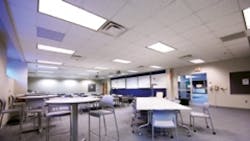
Classrooms, planning centers, breakout spaces and teaming areas serve different learning needs; furniture must support the learning styles that are being used simultaneously in these spaces. The furniture must enable teachers to serve as facilitators in collaborative settings through presentation, discussion, teamwork, project-texting and individual work. A combination of soft seating, work surfaces with chairs, tables and technology (laptops, handheld mobile devices, whiteboards, etc.) turn traditional classrooms into flexible studios. The "front of the room" is anywhere, supported by a mobile unit for the facilitator.
Movement: a paradigm shift
Traditional fixed furniture forces children to sit up straight and still. The opinion that movement detracts from concentration no longer is accepted. Studies show that rigid chairs cut off blood flow under the legs, and poor posture and organ restrictions result from being hunched over. To alleviate these effects, students rock forward or lean backward, which can be dangerous. In a rigid, fixed seat, body stress increases and cognitive performance decreases.
"Old" furniture doesn’t support new learning approaches. Combined bench/desk furniture, still present in some places, doesn’t support education reform. The furniture prevents teachers from accommodating active learning, group work, cooperative learning, simulations and role play.
The shift to flexible, adjustable seating and inclining movable tabletops employs principles that satisfy the desire for movement. Inclined seating enables front-to-back position movement, adjusting the center of gravity, and providing a three-dimensional rocking mechanism. Full height-adjustable round tables support mobility. Tall upper cabinets free up more floor space for variations in activities. Furniture with castors facilitates frequent rearrangements of learning spaces.
The right fit
Adjustable furniture fits each student. In high-use spaces such as computer labs, students need furniture that adjusts easily to serve multiple age groups. Seat heights range by 8 inches and table heights range by 12 inches for optimal sitting conditions.
Flexible chairs support weight distribution while maintaining good posture. Transitioning from sitting to standing enhances dynamics with mobile full height-adjustable tables and desks. Adjustable mechanisms enable students to move quickly from sitting to standing, switching from individual work to project-based team learning. Furniture designers and manufacturers can provide ranges of adjustable and flexible tables and chairs, which enable spaces to be reconfigured for various activities.
Standing, moving or lying on a soft surface facilitates dynamic learning. Studies show that changing positions improves the learning of different content. Forward-sitting positions support writing and reading; rear-sitting positions support listening and dialogue; movable, narrower-lower-back chairs support a "riding position" for circular groupings. Other positions include sitting on the knees and sitting one leg under the other.
Integrating technology
We are witness to the rise of ubiquitous wireless and handheld learning devices. Technology can be moved, stored and safeguarded. Portable laptop carts store, secure and charge computers during safe transport; utility carts support laptops, flat panels, projectors and document cameras, with shelving for electronics, cords and accessories. Portable tables with power/data ports are configured together and stored when unused. Portable screens for floor/tabletop setup enable schools to have "on-the-go" presenting capability.
Contemporary pedagogy emphasizes individual learning, small-group discussion and large-group collaboration. The dynamic learning environment is created by integrating technology equipment with movable furniture. Modular sofa islands serve as "places" for group work or video viewing. Technology limited to dedicated spaces has more simplified security than in facilities where laptops are used throughout the school; this approach, however, limits flexibility and fails to connect the trends of technology integration.
Procurement and training
Furniture procurement should be based on how it affects learning, instead of personal preference, appearance, or what was purchased previously. Develop budgets early to plan for the appropriate furniture. Traditional furniture should not replace worn equipment; install mockups to test ergonomic furniture varieties. Compare the pedagogical benefits against costs.
Effective procurement is integral to teacher involvement and training. Early involvement of administration, teachers and students help define learning activities. With training on the use of furniture, teachers will change their delivery methods, their movement around the classroom, and how students interact with one another. With the right furniture and layout, teachers are more likely to move to all areas of the classroom, helping children individually and in small groups. Student orientations on how they should use new furnishings will benefit their learning. It is essential to provide hands-on orientation for teachers and students in the use of dynamic furniture—bringing planning, design, procurement, training and student engagement successfully full circle.
Erickson, AIA/NCARB/REFP, is president of ATS&R Planners/Architects/Engineers, Minneapolis, a multi-disciplined firm specializing in pre-K to 12 and post-secondary school planning and design. He can be reached at [email protected].