Taking Green to new Levels
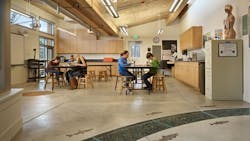
The architects and engineers had sweated over the details of the energy consumption at Richardsville Elementary School in Bowling Green, Ky., in an effort to deliver a net-zero-energy building.
But after the facility opened its doors to students in 2010, the engineers who were monitoring the facility’s energy numbers were dismayed by an unplanned and unwanted spike in electricity that threatened their net-zero goals. Had they miscalculated their energy projections or used wrong assumptions that skewed their predictions?
A little legwork and the culprit was fingered: The ice cream guy.
It turned out that after the school opened, a vendor brought a freezer to the school to sell ice cream treats to the children, and the power it was consuming was defeating Richardsville’s energy-saving goals. The school now has the freezer operating only during lunch periods, and during other times, it is unplugged and wheeled into a walk-in freezer.
That’s the kind of detail that many schools and universities are putting into the design, construction and operations of facilities as they search out every possible way to reduce the consumption of energy, water and other resources. As the green school movement evolves and matures, education institutions are raising the bar of what can be done to provide sustainably designed facilities that are managed in an environmentally responsible way.
“You really have to start to pinpoint where you can reduce as much of the energy as possible,” says Kenny Stanfield, architect on the Richardsville project for Sherman Carter Barnhart. “It’s a matter of knowing where your energy use is.”
School focus
Some schools and universities have been striving for years to save natural resources and operate more efficiently. Organizations such as the Collaborative for High Performance Schools (CHPS) and the U.S. Green Building Council have not only provided education institutions with guidance on how to design, build and operate in the efficient and environmentally friendly way, but also established formalized ways for those institutions to be recognized for achieving sustainable buildings and practices. By seeking status as a CHPS-verified school or certification through the U.S. Green Building Council’s Leadership in Energy and Environmental Design (LEED) rating system, schools and universities had tangible documentation that a facility was eco-friendly.
By sheer numbers, not to mention their educational impact, school facilities were seen as a vital part of the greater green building movement, so the Green Building Council decided in 2010 to create the Center for Green Schools.
“Twenty-five percent of the U.S. population goes to a school every day,” says Jenny Wiedower, K-12 manager for the center. “It was a ready-made audience, and we thought the green message would resonate with them.”
The center has teamed up with the federal government, non-profit groups and other organization in an attempt to further the understanding of how green school can be beneficial. It has been involved in creating the Green Apple Day of Service, in which students and community members around the world are encouraged to carry out service projects to support healthful and sustainable schools. Last fall’s first Green Apple Day resulted in more than 1,200 projects.
The center helped the U.S. Department of Education establish its Green Ribbon Schools program, which recognizes schools that have taken a comprehensive approach to creating green environments.
“As the green schools movement grows, we become better informed about what makes schools buildings high-performance and healthy,” Wiedower says.
Net-Zero
Pursuing a net-zero-energy design at Richardsville Elementary seemed like a logical step for the Warren County district and the architects, Stanfield says. Sherman Carter Barnhart had worked with the district on earlier school construction projects and already had achieved impressive energy savings. Plano Elementary School in Bowling Green was using 28 kBtus per square foot per year, compared with the average school in the region, which uses 73 kBtus, Stanfield says.
“The utility came out to Plano and installed a meter because they couldn’t believe the numbers of how well the school was performing,” says Stanfield.
The design for Richardsville pushed the energy savings further. Among its sustainable elements: north-south building orientation to enhance daylight; a compact building configuration and volume; insulated concrete forms; geothermal heating and cooling; controls that monitor occupancy, motion and carbon dioxide; light shelves, clerestory windows and solar tubing to bring daylight into the school; combi-ovens instead of fryers in the kitchen and tilting skillets, which enable the school to eliminate Class 1 fume hoods.
The result is a building that uses only 18 kBtus per square foot a year. Very good, but not net zero. That’s where the 2,000 solar panels on the school roof and the 700 panels on the parking structure come in.
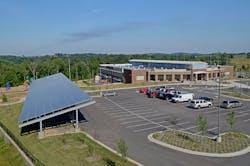
The energy generated by the solar array at Richardsville is more than enough to offset the modest amount of power used in the school building. The excess energy produced is being bought by the area’s electric utility, the Tennessee Valley Authority, for 22 cents a kilowatt hour, the school says. In 2012, that amounted to more than $37,000.
The unprecedented achievement in energy efficiency for a school helped Richardsville win recognition as part of the Department of Education’s inaugural class of Green Ribbon Schools in 2012.
Setting the bar higher
As designers and builders gain more knowledge and become more skillful in making facilities more sustainable, the challenge of delivering a green project is not as daunting. Schools and designers that once may have been satisfied to receive basic LEED certification or a silver rating now aim for the higher gold or platinum ratings.
In Seattle, architects Stacy Smedley and Chris Hellstern with KMD Architects decided to try to meet what some have called “the world’s most rigorous building performance standard” with their design work on a science wing for the Bertschi School, a private K-5 school.
The Living Building Challenge 2.0 standards, which were created by the Cascadia Green Building Council, use the metaphor of a flower with seven petals: site, water, energy, health, materials, equity and beauty.
“It’s especially suited for schools,” Smedley says. “Kids get the flower metaphor—that energy comes from the sun and rain. It’s not complicated. It engages kids in the design process.”
Within the seven petals are a total of 20 imperatives. Among them are net-zero water, net-zero energy, limits to growth, ecological water flow, civilized environment, healthy air, beauty and spirit, and inspiration and education.
The standards are difficult to achieve and require a strong commitment from all those involved in a project. “It’s about caring that what you’re doing is right,” says Smedley.
With the Living Building standards as a roadmap, the Bertschi School erected a 3,380-square-foot Living Building Science Wing, which includes a 1,425-square-foot building. The sustainable features, all visible to students, include net-zero energy, net-zero water, a solar array that produces all of the building’s energy, a rainwater cistern, a potable water-treatment system, a living wall of tropical plans to treat greywater, a green roof, a composting toilet and an ethnobotanical garden to grow food.
Its achievement in sustainability has earned the Science Wing honors from the Center for Green Schools as one of two Best Green Schools in the K-12 category. The Science Wing is a small structure, but Hellstern says, “it can be done in a larger building.” He notes that a six-story, 50,000-square-foot office building nearing completion in Seattle has been built to Living Building Challenge standards.
“Just as LEED broke barriers, we need to continue to re-educate manufacturers and consultants,” says Hellstern. “You need people who have the right mindset who can bring people along.”
Sidebar: Soaking in the Ohio Sun
Anyone wondering about Oberlin College’s commitment to sustainability can find an answer among the 7,722 photovoltaic panels that fill a 10-acre field at the Oberlin, Ohio, campus.
The recently installed 2.27-megawatt array—the largest of any college or university in Ohio—is expected to generate about 3 million kilowatt hours of electricity per year, or about 12 percent of the college’s annual consumption.
That’s one of the reasons that Oberlin has been named the best green four-year higher-education institution for 2012 by the Center for Green Schools.
“Not only are sustainability lessons incorporated into classroom curriculum, but also into the rest of the campus environment—including its architecture, landscapes and campus culture,” the center says.
Oberlin decided in 2006 that new construction and major renovation would be designed and built to meet LEED silver certification standards. It was one of the nation’s first higher-education institutions to signing the American College and University Presidents Climate Commitment and embrace its goal of climate neutrality.
Kahn Hall, a residence hall for first-year students, has a sustainability focus. Those living there have pledged to incorporate sustainability into their daily life. They strive to conserve water and energy, reduce waste, and avoid bringing cars to campus.
The college also has a “Green Room” program that enables students to certify the sustainability of their residence hall living space.
“We want sustainability to be the default condition on campus, where it becomes just the way we live and work, and how we do things at Oberlin,” says Rob Lamppa, Oberlin’s director of sustainability and energy management.
Sidebar: Greening staff members
For educators seeking to support and promote sustainable practices in their schools, the Center for Green Schools has established the Green Classroom Professional Certificate Program.
“The program teaches what will and does affect health and the environment,” says Jenny Wiedower, K-12 manager for the center. “They will learn about practices they can carry out to promote health among students and school occupants.”
The center says the program is geared for pre-K to 12, teachers, paraprofessionals, administrators and other pre-K to 12 stakeholders.
“It’s targeted for those who have primary ownership of the space they occupy,” Wiedower says.
The training will identify features that support or impede environmentally healthful, resource-efficient and sustainable learning spaces.
The center hopes that those who complete the program will help education institutions provide the best environment for student academic performance, decrease absenteeism caused by environmental factors, and support environmentally responsible practices.
About the Author
Mike Kennedy
Senior Editor
Mike Kennedy has been writing about education for American School & University since 1999. He also has reported on schools and other topics for The Chicago Tribune, The Kansas City Star, The Kansas City Times and City News Bureau of Chicago. He is a graduate of Michigan State University.