Community Commitment
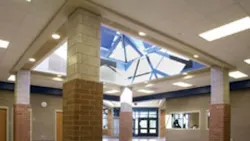
Education institutions that embrace green concepts in their construction projects are able to provide safe and healthful learning environments that are responsive to the community. Carrying out these strategies can enhance student learning, reduce health and operations costs, and enhance the quality of a school. Moreover, these high-performing schools become visible statements of a community’s commitment to future generations of learners.
Doing your research
Research shows that green, high-performing schools provide the following benefits:
•Improved student performance.
•Reduced absenteeism.
•Increased comfort for teachers and students.
•Reduced liability exposure.
•Reduced operations and maintenance costs.
•Reduced reliance on fossil fuels.
•Reduced environmental impact.
•Better educational examples for students and the community.
One method for evaluating a green school design is the U.S. Green Building Council’s (USGBC) Leadership in Energy and Environmental Design (LEED) rating system. LEED for Schools, an application of LEED that recognizes the unique aspects of design and construction of K-12 schools, addresses issues such as master planning, classroom acoustics, mold prevention, indoor air quality and joint use of facilities.
During the planning and design phase of a project, a LEED-accredited architect can guide the education institution with green design strategies.
Best practices
Many of the best examples of green concepts in construction projects are common-sense strategies that result in quick payback, low energy consumption and enhanced learning environments. During the design and construction of a project, education institutions can focus on sustainable sites, water efficiency, energy and atmosphere, materials and resources, environmental quality, and innovation and design to incorporate cost-effective concepts as follows:
•Sustainable Site:
-Design a compact two-story building to reduce the footprint and site impact.
-Use native trees or shrubs to reduce watering and maintenance.
-Shield lighting to avoid light pollution to neighbors.
-Plant trees and grass islands to reduce parking lot heat buildup.
-Provide priority parking for hybrid vehicles and carpools.
-Design bio-swales to clean and cool water runoff.
-Retain stormwater on site to control water quality and quantity.
-Provide bike racks and walking paths to encourage alternative transportation.
-Protect open space and wildlife habitats for environmental learning.
-Reuse on-site soil material during construction to eliminate off-site trucking disposal.
•Water Efficiency:
-Use a stormwater-
retention pond for irrigation, which reduces potable water usage.
-Provide water-reducing fixtures with sensors on urinals, lavatories and water closets.
-Install waterless urinals and dual-flush water closets.
•Energy and Atmosphere:
-Orient classrooms in the north-south direction for optimal daylighting.
-Provide occupancy sensors for lighting and ventilation.
-Design energy recovery and thermal energy storage in mechanical systems.
-Incorporate ice storage for mechanical cooling systems.
-Provide variable-
frequency drives in HVAC design.
-Conduct energy monitoring and trend logging of energy usage.
-Use renewable energy sources.
-Consider geothermal mechanical systems.
-Design a well-insulated building for energy savings.
-Integrate commissioning of HVAC systems into the project.
-Use refrigerants with low ozone depletion.
-Use appropriately sized high-efficiency chillers, boilers, motors and filters.
•Materials and Resources:
-Specify regional materials to reduce transportation costs.
-Specify products with recycled content and low- or no-VOC (volatile organic compounds) emissions for indoor air quality.
-Provide durable, long-lasting, easily cleaned materials.
-Consider using recycled glass-chip terrazzo, low-maintenance glazed or burnished-block walls, ground-concrete floors, linoleum flooring, bio-based floor tile, low-VOC water-based paints and sealers, wood from certified forests (floors, doors, etc.), energy-efficient glazing, carpet tiles with recycled materials, steel with recycled content, and furniture with formaldehyde-free core materials.
-Use reflective roofs or green planting roofs, which reduce temperature as light and heat is reflected back into space rather than absorbed and radiated locally.
-Specify low-dust, high-impact, recycled-content acoustical ceilings.
-Incorporate waste management during construction.
-Design space for recycling into the building project.
-Specify recycling processes during construction.
•Indoor Environmental Quality:
-Incorporate daylighting throughout the building with outdoor views.
-Include detecting devices for air quality and flow assessment.
-Design luminance levels to reduce glare.
-Situate mechanical equipment and VAV (variable-air-volume) boxes for acoustical control.
-Provide acoustical treatment in corridors, classrooms and large-group spaces.
-Provide voice-enhancement technology in classrooms.
-Incorporate 100 percent fresh air via mechanical systems with a natural ventilation option.
-Specify high-performance energy-management controls.
-Consider displacement ventilation to minimize air particulates.
-Isolate exhaust systems to reduce contaminants.
-Situate controls for individual space thermal comfort and moisture control.
•Innovation and Design:
-Design multiuse spaces resulting in less square footage.
-Use the school building as a teaching tool.
-Design secure zones for gyms, cafeterias, auditoriums and libraries for community use.
-Emphasize community and school shared use of building and play fields.
-Specify water- and energy-efficient food-service design.
-Engage utility companies for energy rebates.
-Prevent air and moisture contamination of absorptive materials during construction.
-Specify a tobacco-free construction site.
-Select materials and systems based on life-cycle cost analysis.
-Use negative-air machines and high-efficiency particulate air vacuums for dust control during construction.
Setting an example
Research has found that asthma, flu, sick-building syndrome and respiratory problems result from unhealthful schools. Green design can alleviate those problems. Temperature comfort and control affect teaching quality and student achievement. Effective daylighting strategies can reduce student absenteeism and encourage greater student performance. Healthful schools with daylighting, improved ventilation and acoustics, non-toxic materials, and improved air and light quality provide for a more productive learning environment.
High-performance schools can become teaching tools that help students and community members learn about resource management and conservation. The building becomes a model to teach about responsible fossil-fuel usage, reduced water usage, energy efficiency, recycling, selection of materials and thorough planning.
Erickson is president of ATS&R Planners/Architects/Engineers, Minneapolis, which specializes in pre-K to 12 school planning and design.