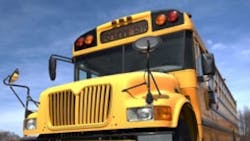
Violence and natural catastrophes have made schools and universities more vigilant about protecting students and staff on their campuses. But students and workers also need to get to and from their schools, and once on a campus, they need to get from one facility to another. So administrators must make sure security is an integral part of their transportation planning. For elementary and secondary schools, transportation security in most cases means a safe bus ride between school and a student's neighborhood; at a college or university, security is more likely to focus on protecting students and staff as they move from place to place on campus.
On the bus
For students in kindergarten through 12th grade, the most common method of transportation is the yellow school bus. Some safety features are simple and familiar, such as a stop arm that extends from a bus to alert vehicles in other lanes that children are getting on or off the bus.
Another mechanical device that has been added to school buses in recent years is a crossing arm. It is designed to prevent people from walking in a driver's blind spot in front of the bus. The arm typically is attached to the front bumper, and when opened, it extends several feet in front of the bus when the door opens The arm forces children getting on or off the vehicle to avoid the blind spot and walk several feet in front of the bus before crossing in front of the vehicle.
Technological help
Mechanical arms and flashing lights aren't enough to persuade other drivers to follow school bus safety laws. Thousands of vehicles pass by school buses even though extended stop arms signal them to stop.
Technological advancements can help school systems and law enforcement crack down on drivers who ignore stop arms. Buses can be outfitted with exterior cameras that photograph license plates and the faces of drivers that pass a bus.
In addition, school systems can install video systems inside buses to monitor student behavior and deter misconduct. The affordability of digital systems has enabled many schools to replace videotape systems with digital video recorders (DVRs). With a DVR, drivers or staff members do not have to change tapes, and in some setups, authorities can view the video captured on a bus over the Internet.
Another piece of technology that enhances school bus security is a global positioning system (GPS). For school transportation officials, GPS can tell them where their buses are, whether they're taking the right route and whether they're on schedule.
Some security systems also use radio frequency identification (RFID) together with GPS to add another layer of security. Before boarding or getting off a bus, students are required to display ID cards that have RFID tags. The system records when and where a particular student gets on and off a bus.
Upgrading buses
With sophisticated systems available to bolster bus security, safety advocates are trying to get such features onto more buses. The U.S. Yellow School Bus Project, a project supported by the Points of Light Foundation, is a public-private partnership with a goal of providing interoperable communications, tracking, surveillance and transportation to the nation's school buses as a standby resource for public safety.
The technology the project would like to see on buses include hands free cell phones and radios; digital video recorders (up to four); GPS; and wireless and cellular networking.
Shuttle service
Colleges and universities, often with numerous buildings spread across a sprawling campus, need to provide a safe climate for students and staff to get from one facility to the next. Many campuses routinely offer classes and other activities at night, so safe nighttime transportation is critical.
At the University of Maryland, Baltimore, students have a number of transportation options that offer secure ways to get around campus. A free shuttle service is available from 5:30 p.m. to midnight for students, faculty and staff. A user calls to request a ride and must show a university ID to board the van. The service covers the campus' nearby neighborhoods.
For more secure traveling, the university's police force provides an escort patrol vehicle for students, faculty or staff members from 6 p.m. to midnight. Officers also offer a walking escort service for people going to a spot on campus that is not along the escort vehicle routes.
At the University of Texas in Austin, the school's transportation services department has teamed up with the city's police and its transit service to provide a kind of designated driver for students. The Eating and Entertainment Bus, also called the E-bus, gives students, staff and faculty who have a university ID free rides to and from Austin's entertainment district on Thursday, Friday and Saturday nights (from 8:30 p.m. to 3:30 a.m.).
Belt debate
The safety feature most identifiable to car drivers and passengers — the seat belt — is not required on most school buses, as a debate continues over whether they are necessary or worth the cost.
The National Highway Traffic Safety Administration says it has decided that “compartmentalization” is the best crash protection for riders on large school buses. “Through compartmentalization, occupant crash protection is provided by a protective envelope consisting of strong, closely-spaced seats that have energy-absorbing seat backs,” the NHTSA says.
Still, several states require lap-shoulder safety belts on school buses. Although it is not calling for seat belts on large buses, the U.S. Transportation Department has proposed requiring three-point belts on smaller buses (less than 10,000 pounds gross vehicle weight). The department also wants to raise the minimum height of seat backs to 24 inches, 4 inches higher than the existing rule.
Kennedy, staff writer, can be reached at [email protected].
Number of school buses transporting U.S. students.
25.1 million
Number of U.S. students who regularly ride school buses.
4.8 billion
Number of miles traveled per year by U.S. school buses.
Source: U.S. Department of Transportation
Training for bus security
The Transportation Security Administration (TSA), part of the U.S. Department of Homeland Security, has developed a safety program to help school bus drivers and other school personnel identify potential security problems.
The School Transportation Security Awareness program was developed with the National Association of State Directors of Pupil Transportation Services, the National Association of Pupil Transportation and the National School Transportation Association.
“It is designed to provide school bus drivers, administrators and staff members with information that will enable them to effectively identify and report perceived security threats, as well as the skills to appropriately react and respond to a security incident should it occur,” the TSA says.
The topics covered: defining terrorism and terrorists; identifying threatening people and situations; potential weapons and probability of use; joint planning between organizations and leadership.
The program consists a 24-minute DVD of a simulated school bus hijacking and web-based, self-study modules offered in both English and Spanish. The agency offers the program at no cost to any school division and school transportation entity that requests it. (See www.tsa.gov/what_we_do/tsnm/highway/stsa.shtm for more information).
About the Author
Mike Kennedy
Senior Editor
Mike Kennedy, senior editor, has written for AS&U on a wide range of educational issues since 1999.