In the Game With a new Athletic Facility (with Related Video)
An athletic training center plays a key position in a winning student-athlete recruitment strategy. It is the place student-athletes will think of as "home" during their college careers. As such, it has a central place in their development as successful people, students and competitors.
Today, academic institutions use strategic siting and design to develop state-of-the-art athletic training facilities that are highly functional, healthful, interactive and energetic. They can help inspire pride in the community and express aspirations for future success.
Fundamentally, the facility needs to be a healthful environment: filled with natural light and materials, having exceptional indoor air quality and functional, high-performing spaces. It must have the features that attract high-performing student-athletes and coaches; training, strength and conditioning spaces adequate to meet the demands of student-athletes; practice and competition spaces; high-tech, "wired" locker rooms and digital film screening rooms; and places to decompress and hang out with their teammates. Added to this list would be dedicated spaces for coaches and staff, with well-designed, wired office suites and conference rooms, as well as spacious locker rooms and some of the creature comforts of home.
A New Paradigm
The designs of the best facilities look beyond the fundamentals of square footage and equipment. Often, it is difficult for student-athletes, parents, coaches and alumni to identify what draws them to an athletic facility, training or competition, or what makes them experience a sense of pride and their community's aspirations. Therefore, the vision of a facility should express the institution's history and its aspirations for academic and athletic excellence.
The challenge is to embody institutional vision using simple building types. In the past, athletic training facilities were big-box structures whose size and relationships to playing fields or courts dictated sites at the edge of campus. Over time, student-
athletes typically have become scattered around campus, marginalized from the general student body.
Today, the constraints of an urban, landlocked campus may dictate placing facilities on unconventional sites. Here, it is important to design, situate and organize the facility programmatically to create connections and cohesiveness with the entire campus in terms of access, pedestrian flow and building usage. This can be accomplished through a master-planning process that reorganizes the campus to create an athletics precinct that includes all dedicated athletic training facilities.
The institution gets the best leverage from a facility that is designed to maximize its use even if it is focused on one or two sports. A cost-effective approach to planning and design yields multiples uses for major spaces, including practices for other teams and summer camp programs.
In its architecture, too, the aspirational athletic training facility needs to be more than a big-box gym. The best design expresses the quality of an institution's unique time and place without copying an existing style; it also looks to the future. For example, the building massing, form and style may be contemporary, but a local granite or brick is used to integrate the new building with campus landmarks. The goal and the result should be a facility that inspires student-athletes, coaches, the campus community, alumni and visitors.
Healthful spaces
Whatever its architectural expression, the facility needs to be a healthful environment: characterized by abundant natural light, exceptional indoor air quality and safe, high-performing spaces. These include sustainable, VOC-free materials and finishes; natural materials, fixtures and finishes that are durable and easy to clean and maintain; and light, fresh colors, such as warm, glare-free shades of white.
A healthful environment also depends on a watertight building envelope. When architects and engineers use proven building science methodologies to design a building, they properly detail the wall and roof assemblies to keep out water and water vapor and control air temperature. They also use the proper insulation and installation methods to reduce thermal transfer.
A watertight building envelope is designed and constructed based on its location; what is appropriate for Louisiana may not be appropriate for New York or California.
Building science — and practical experience — have proven that designing a building's thermal envelope in a durable and cost-effective manner in coordination with the mechanical system enables equipment to be right-sized, not oversized.
What Do Student-Athletes and Coaches Want?
Top student-athletes and coaches look for Division I-caliber facilities for training, strength and conditioning, practice and competition. They also want their facilities to be wired. Think locker rooms with ports for MP3 players and iPods; ceilings inlaid with speakers; a digital film screening room with HD projection, state-of-the-art lighting and screening-room-style chairs; and a fully equipped video editing room. They look for hangout spaces and kitchenettes, and for study spaces with high-speed WiFi.
Similarly, top-performing coaches seek a variety of teaching spaces, wired office suites and conference rooms, spacious locker rooms and kitchens. Digital film technology is a must so that digital practice films can be edited quickly in a central editing room and transmitted to individual coaches. The film room should be designed as a teaching classroom that doubles as auditorium and theater.
Case study: The Hertz Center at Tulane
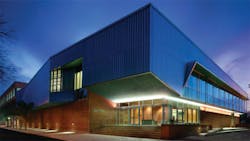
The Hertz Center at Tulane University, New Orleans, is a new practice and training home for basketball and volleyball. The $13 million, 43,000-square-foot building is the first piece of an athletics master plan that reorganizes the northern portion of this dense urban campus. Currently, the building stands alone, providing an edge to existing campus pedestrian and vehicular routes.
In the near future, the Hertz Center will nest into a new, 30,000-capacity football stadium, which is on the drawing boards for a 2014 completion. These new facilities, along with the Wilson Athletics Center, will create an athletics quadrangle and provide a figurative and literal epicenter for the athletics precinct of Tulane's campus.
The vision of the university's leaders, including athletics director Rick Dickson, was to create a central home for student-athletes to express the university's commitment to education, socialization and athletic performance.
The architectural design diagram is deceptively simple. A first-floor base of local "St. Joseph's" brick integrates the Hertz Center with historic buildings on campus and visually supports a perforated zinc-panel rain screen at the second floor. The rotation of these two stacked rectangles creates voids that introduce indirect natural light to the internal spaces. The faceted zinc panels have a reflective quality that suggests movement as the sun tracks through each day and season.
The main gym has nearly 15,000 square feet of court space with four main basketball goals and eight additional basketball goals. Each court includes an iPod docking station and mounted cameras.
The 3,000-square-foot athletic training, strength and conditioning area is adjacent to the main practice area and visible through an all-glass front from the gym. The training room is equipped with a cold tub, two taping tables and four treatment stations. The strength and conditioning area is equipped with treadmills, elliptical machines and weight-training equipment.
Each program has a 1,200- square-foot locker suite with wooden lockers, showers, lavatories and lounges. Each lounge is furnished with sofas, a refrigerator, microwave and computer desks, and is equipped with a television, iPod docking stations and inlaid ceiling speakers.
The equipment room has rolling storage racks, two large-capacity washers/dryers and 1,100 square feet of storage.
On the second floor are 1,350 square feet of office space for a head coach, three assistant coaches and an operations director. A 400-square-foot conference room has a television, projection screen and dry-erase boards.
A 600-square-foot digital film room is equipped with a mounted HD projector, state-of-the-art lighting and audiovisual system, and 32 leather chairs. The 215-square-foot video office is equipped with a digital editing and duplication system and a filming window that is open to the courts.
With all of these high-quality features, the cost of the facility is mid-range for athletic facilities of its type and size as a result of the value-minded approach of the design team, which encouraged the university to invest in materials and equipment where they really count: in the components that people see, touch and use every day.
Riccardi, AIA, is vice president of Gould Evans Architects and Planners, Kansas City, Mo. He can be reached at [email protected] or (816)701-5392.
Related Video
Watch a video about the Hertz Center.