A fundamental truth of building security is that one misplaced key constitutes a crack in the armor that protects a space from unwelcome intruders. Now imagine the headaches for administrators and security officials at a large university, where thousands of keys that are distributed to students and staff never find their way back to school officials.
For many years, the solution to this problem has been keyless access-control systems that use swipe or contactless cards to allow authorized users into a campus facility. As technology improves and card systems can be equipped with more functions, the appeal of card-based access-control systems has grown for administrators and facility managers.
"Over the past decade electronic security technology has evolved from an exotic possibility into an essential safety consideration," says School Security Technologies, a report from the National Clearinghouse for Educational Facilities. "Technological improvements are coming onto the market almost daily."
The systems can be bolstered with additional layers of security, such as keypads, biometrics and video monitoring. In addition to access control, some cards can be programmed to include banking, vending, student data, library and other functions.
But unless schools adopt a campuswide card system, they won't be able to take advantage of many of the enhanced functions that computerized cards can offer.
Many schools and universities still depend on keys and locks to enter and exit many of their facilities. In some areas, that is sufficient. School Security Technologies points out when stronger steps might be needed: instances of burglaries in which locked rooms had no signs of forced entry; lost keys; lockdown plans that are heavily dependent on the extensive use of keys.
"If the keys are carried by only some staff members, or if the act of locking the doors would put teachers in the line of fire, or if teachers are likely to be physiologically stressed during the crisis, then an alternative plan is worth considering," the report says.
Overcoming incompatibility
Some large university campuses with many buildings have installed keyless access-control systems at some of their facilities, but often individual departments have acquired different and incompatible access-control systems. Colorado State University in Fort Collins is one of the campuses that over time has acquired a mix of lock-and-key systems and separate access-control systems at its various buildings.
"There are currently over 50,000 keys issued to the campus community, equating to over 20,000 key holders," Colorado State's Key and Access Control Policy states. "Many of these keys have not been returned once the individual left CSU due to employment or enrollment status."
The university now is in the middle of a push to adopt a campuswide system for keyless access control. Mike Rice, assistant trades manager in Colorado State's facilities management department, says the keyless access-control system chosen by the university has been installed in about a third of the 130 or so buildings on its Fort Collins campus.
"It gives us the ability to manage people who are coming through our campus," Rice says. "We eliminate the need to go through thousands of keys a year."
As the budget allows, the university will install the system at more buildings, Rice says. "We do access to the exterior doors first," he says.
Not every entryway on a campus requires elaborate security.
"It depends on what you're trying to accomplish," says Rice. "Putting access control on a closet, or even an office without a specific security need, would be very expensive. But for doors where multiple users are going through at any time, it makes sense."
And some parts of campus may require even more attention. Additional layers of security, such as keypads and personal identification numbers, or biometric identification systems, can prevent security breaches such as a user passing on an access-control card to an unauthorized visitor.
"At certain facilities, where there is more risk, we may install more hardware, such as cameras," says Rice.
One of the more attractive aspects of keyless access control is that a lost or stolen card is not as detrimental to security as a misplaced key can be.
"Electronic key cards can be cancelled instantly with a few key strokes, telling the system to reject the card if it is presented," says School Security Technologies, "and can even send an alert to tell a supervisor that someone has attempted to gain entry using the cancelled card — a far more efficient option than changing all the locks, or pleading with a fired employee to return a key."
Preventing piggybacking
A potential security gap for many electronically controlled entrances is the practice of piggybacking or tailgating. That's when a person authorized to enter a building uses their card or PIN to allow someone who may or may not be permitted into the building to come through the entrance. School Security Technologies says the problem is not the type of system being used, but the behavior of the users. It suggests that schools take these steps to combat the practice:
-
Video monitoring or on-site security personnel that trigger alarms when piggy-backing occurs.
-
Video recording of incidents to identify intruders.
-
An access-control response, such as a lockdown of a second door preventing further entry, and an immediate response from security guards to confront intruders.
"Training for all legitimate users goes hand-in-hand with these tighter measures," the report says.
Vigilant about visitors
Many K-12 schools, reacting to instances of school violence, have become more diligent about checking who is coming in and out of their facilities. Some schools merely require visitors to stop into the central office, sign in and place a sticker on their lapel. Others may ask visitors to show some identification before receiving a sticker. More elaborate systems require visitors to provide identifying information that is checked against sex-offender registries, fingerprints or criminal records before a computer-generated visitor badge with photo is issued.
Edwardsville (Ill.) School District No. 7 installed a badge system in five of its schools for 2008-09.
"Every person visiting a District 7 school is required to show photo identification and is then issued a visitor's badge before proceeding to his or her destination," the district says. "The identification is scanned and entered into a database. The system searches the State of Illinois sex offender registry, and a visitor's badge is printed."
Read the "Hand reader replaces ID cards at university rec. center" sidebar for more information on a electronic access control implementation.
Kennedy, staff writer, can be reached at [email protected].
Notable
50,000
Approximate number of keys issued to the Colorado State University community.
Source: Colorado State University, Key and Access Control Policy
Hand reader replaces ID cards at university rec. center
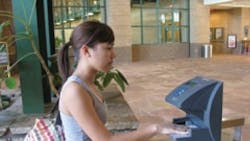
The University of California — Irvine, is replacing the card-based entry system at its Anteater Recreation Center with a biometric hand-scanning device.
The new security system, which was put in place for the Spring 2009 quarter, enables students and other recreation center members to gain access to the facility without an identification card. It also prevents people from gaining entry to the center by using somebody else's ID card.
The university says the hand-geometry system creates a database of members' identities by analyzing more than 31,000 points and recording more than 90 measurements of an individual's hand. Members seeking to enter the center place their hands on a scanning pad, and then enter a personal identification number to confirm their identities.
"The No. 1 suggestion from our members was eliminating the need for ID cards," says Jill Schindele, director of campus recreation.
About the Author
Mike Kennedy
Senior Editor
Mike Kennedy, senior editor, has written for AS&U on a wide range of educational issues since 1999.